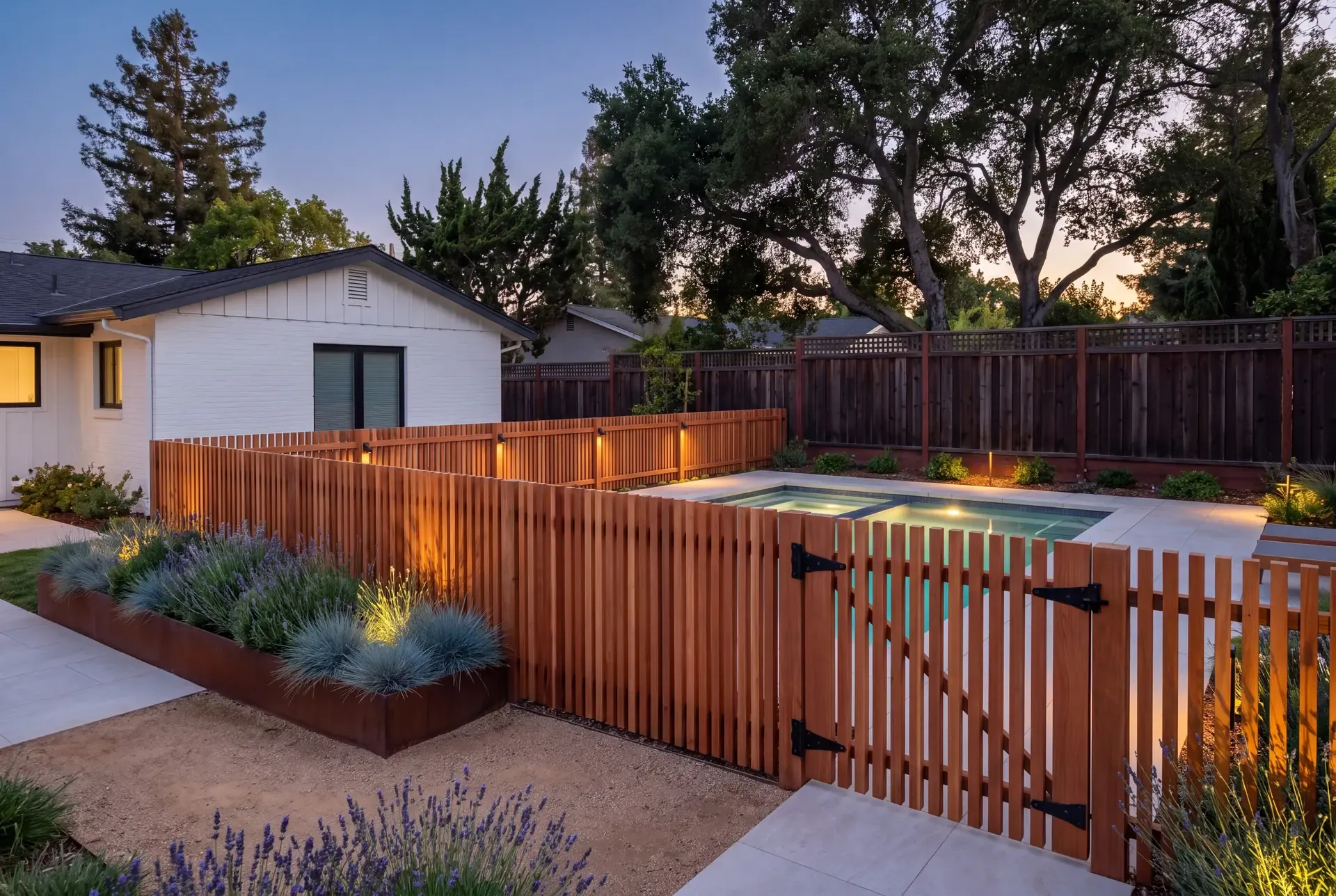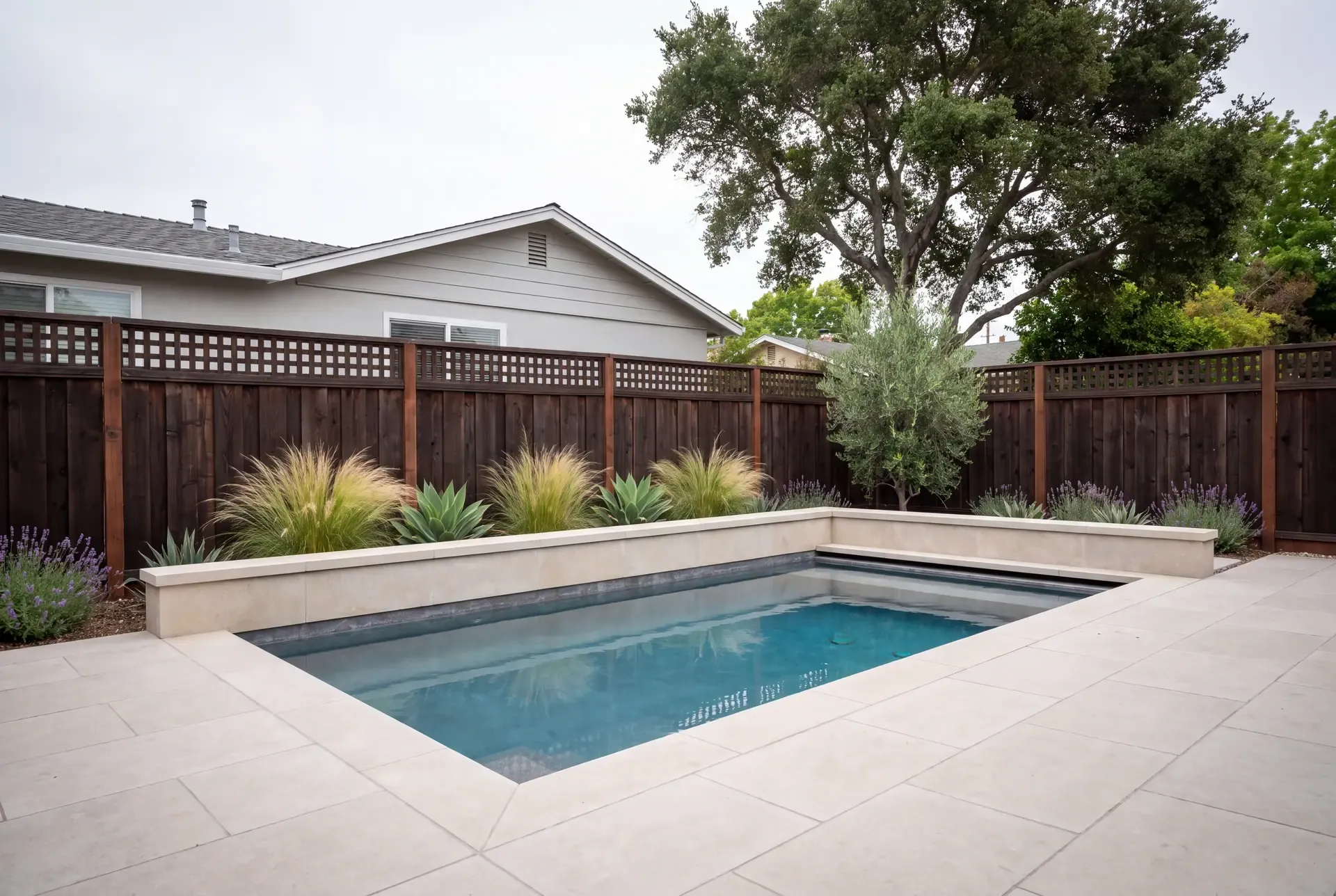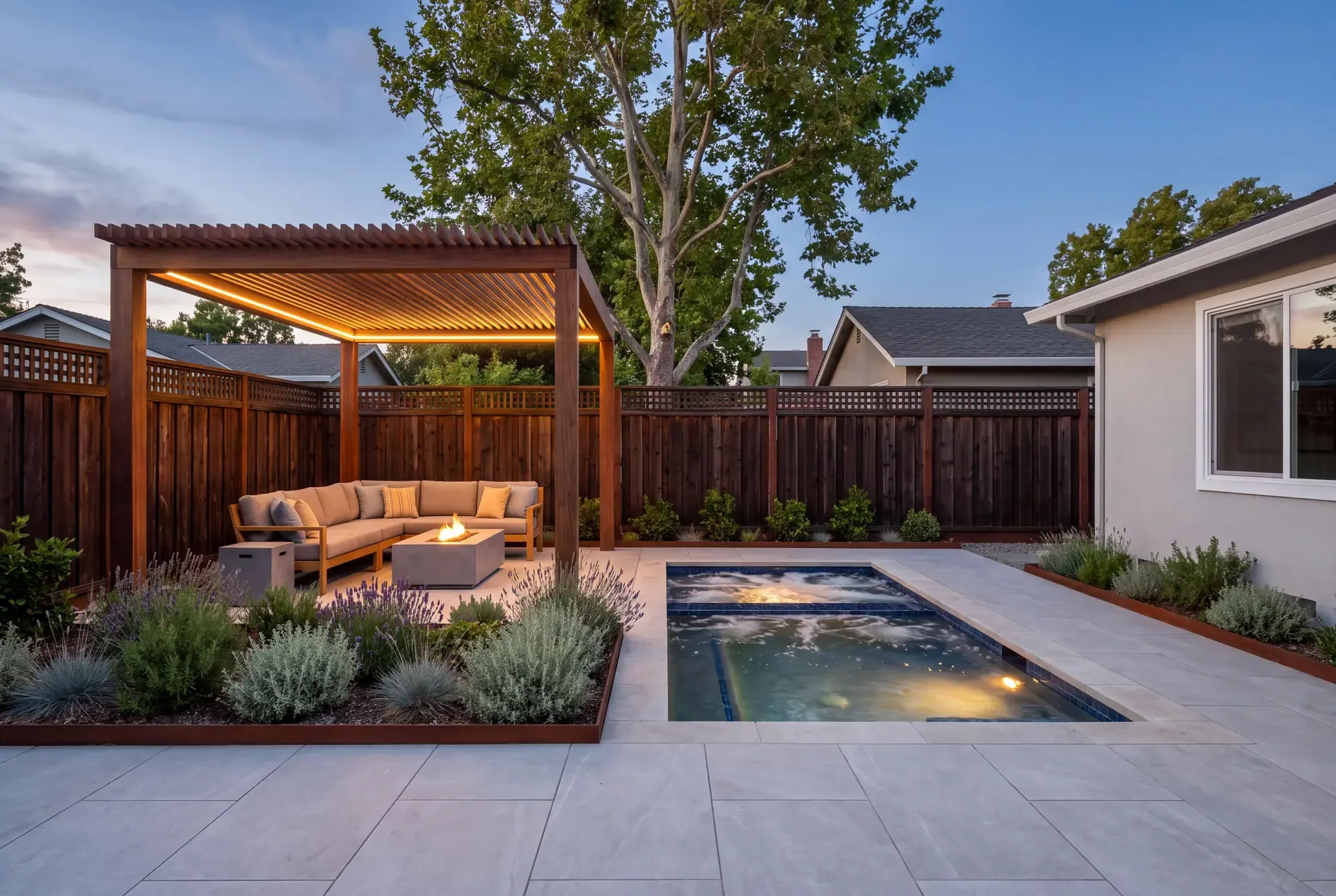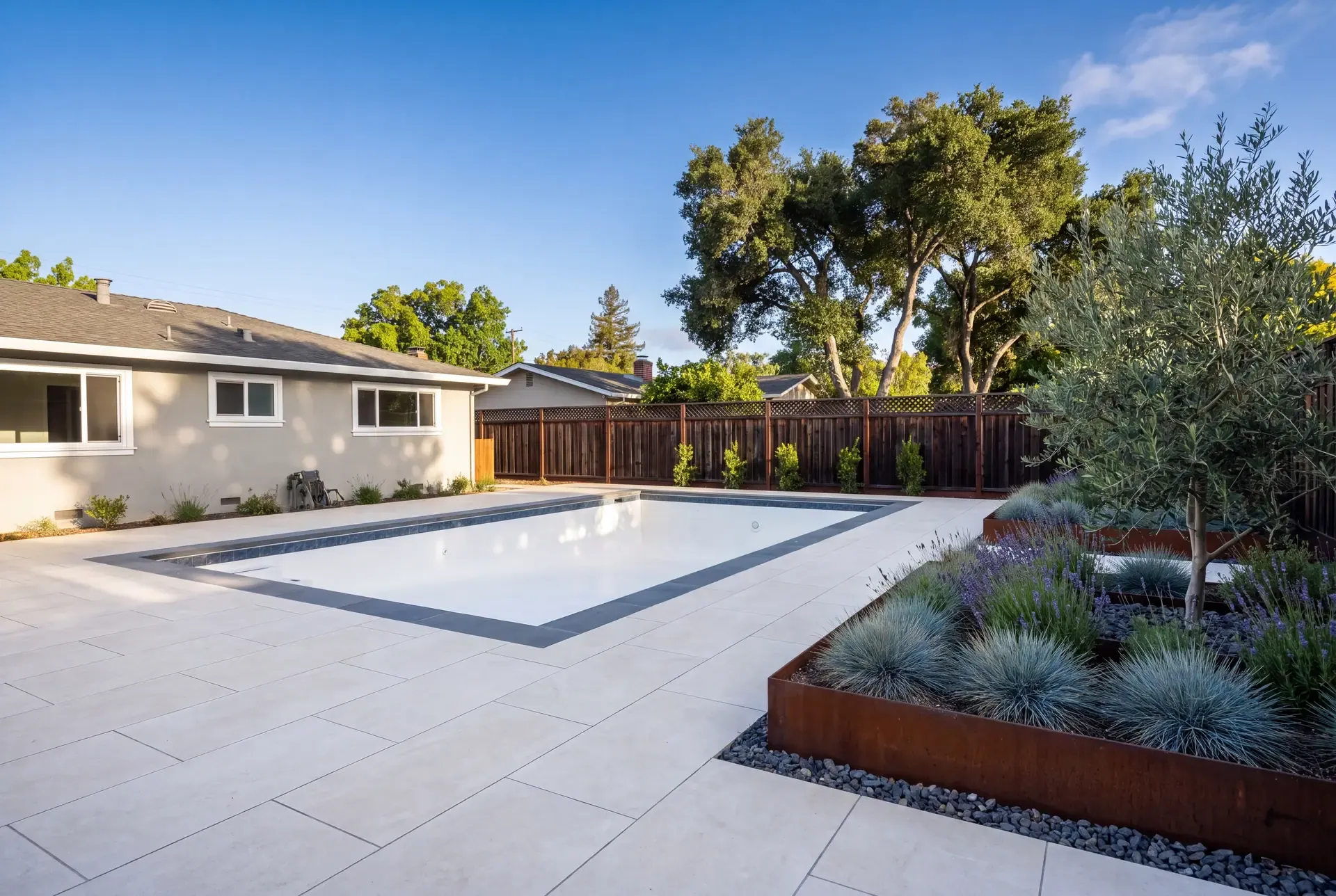
The pool deck is the surface your bare feet touch twelve months a year, the place where something will eventually break or stain, and the surface that takes the worst of Bay Area sun. Choosing among concrete pavers, porcelain pavers, natural stone, poured concrete, and exposed aggregate comes down to how each performs on heat, slip, repair, and longevity.
How a Bay Area pool deck actually has to perform
Most pool deck decisions get made on how the material looks in a one-inch-thick showroom sample. What a pool deck has to do in real life is more specific. Three performance tests apply to almost every Bay Area project:
- Surface temperature underfoot in direct summer sun. This is the most underrated test. A dark bluestone deck in a San Jose July afternoon is something most people only have to learn once.
- Slip resistance when wet. Measured as the coefficient of friction (or, for tile and porcelain, the Dynamic Coefficient of Friction, or DCOF). Codes require a minimum slip rating for pool decks; comfort requires something better.
- Repairability. A pool deck lives. It cracks, stains, settles, and gets heavy furniture dragged across it. The question is whether the damage is fixable in a day, or a project of its own.
All other criteria (color, pattern, feel underfoot, integration with the rest of the landscape) come after these three.
The five materials, side by side
The five pool deck materials we use most often in South Bay and Peninsula projects are concrete pavers, porcelain pavers, natural stone (travertine, sandstone, bluestone), poured concrete with a broom or salt finish, and exposed aggregate concrete. Each is a real choice with real tradeoffs.
Material | Surface heat in direct sun | Slip resistance when wet | Salt & chlorine tolerance | Movement / settling | Single-unit repair? | Staining risk | Bay Area fit |
|---|---|---|---|---|---|---|---|
Concrete pavers | Warm; light colors stay cooler than dark | Good with a textured surface; smoother units can be slick | Excellent; chloride-tolerant concrete mixes | Settles predictably; individual units lift and re-bed | Yes — easy | Low to moderate (sealed) | One of the most common choices here |
Porcelain pavers | Coolest of the five in light colors | Excellent when rated for outdoor DCOF | Excellent; chloride doesn't affect the surface | Rigid; requires a well-prepared base | Yes — straightforward | Very low | Strong choice for modern decks; premium material |
Natural stone (travertine, sandstone, bluestone) | Varies; light travertine stays moderate, bluestone is hot | Varies; honed or textured is good, polished is risky | Good for travertine and sandstone; some bluestones need sealing | Settles with base; units lift individually | Yes — easy | Moderate; needs sealing | Beautiful; specify by performance, not just name |
Poured concrete (broom or salt finish) | Warm; light finishes stay cooler than dark | Good with broom or salt; smooth trowel is risky | Excellent | Cracks with base movement; control joints manage it | No — slab repairs are visible | Moderate without sealer | Most affordable; look matters on the finish |
Exposed aggregate | Warm in light tones, hot in dark tones | Excellent — built-in texture | Good to excellent | Same as poured concrete | No — slab repairs are visible | Moderate without sealer | Classic California look; variable quality in execution |
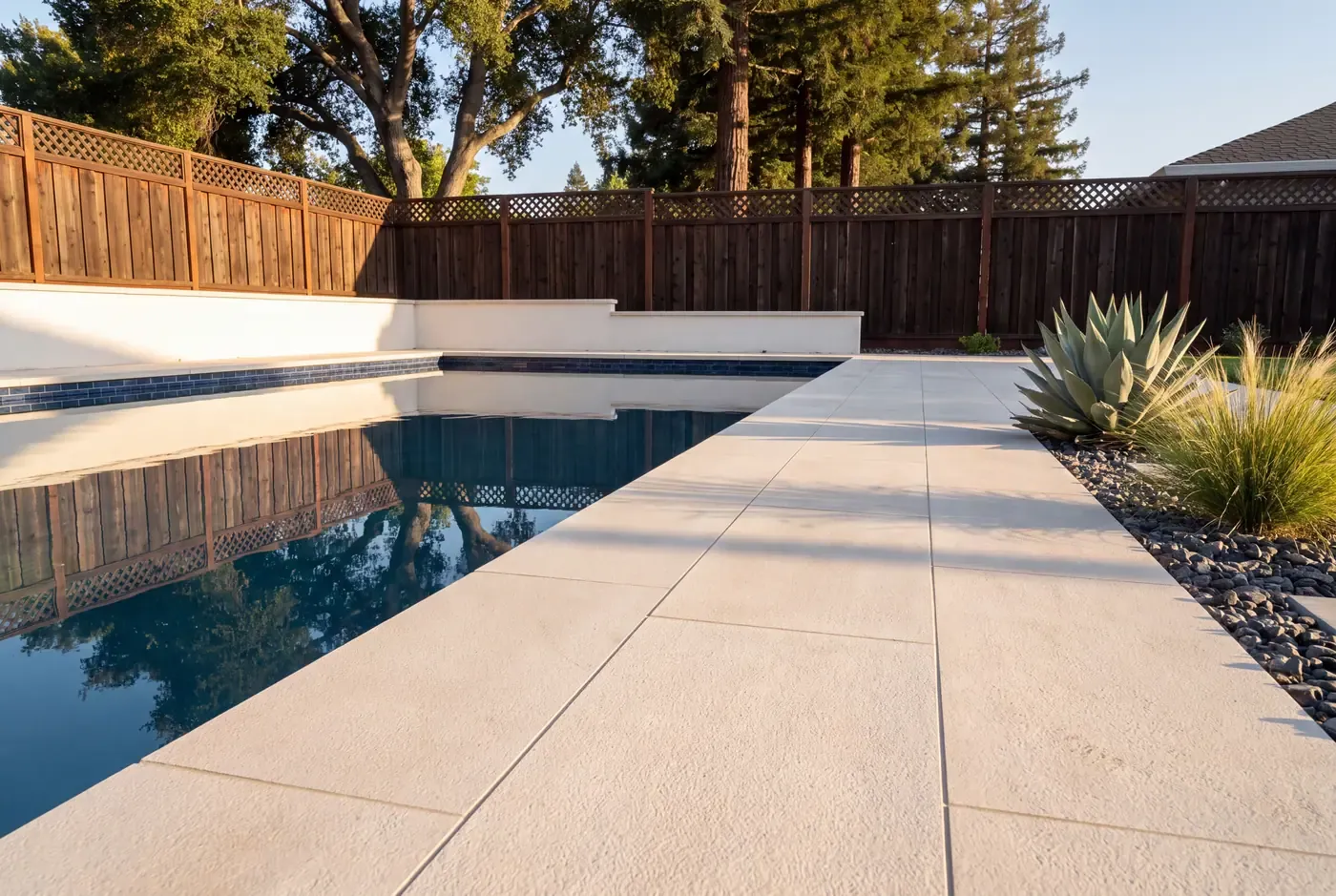
A reading that surprises a lot of homeowners: porcelain pavers, despite their look, are not the hottest option. Light porcelain reflects a great deal of solar radiation back into the sky, and the body of the tile has very low thermal mass, so it doesn't keep storing heat the way stone and concrete do. Among naturals, travertine stays cooler than bluestone primarily because of its lighter color and density.
Slip resistance, honestly explained
The term "slip resistant" without a measurement is marketing language. The relevant number is the coefficient of friction, or COF — a higher number means more friction. For outdoor wet surfaces, the more useful measurement is the Dynamic Coefficient of Friction (DCOF), which the Tile Council of North America (TCNA) and product standards organizations use for hard-surface flooring. Industry guidance for level exterior walking surfaces typically calls for a DCOF of at least 0.42; many pool deck products exceed that, and we typically specify products with a higher value to give margin for algae, soap residue, and worn finish.
Porcelain pavers carry a published DCOF on their data sheet. Concrete pavers can be ordered with a textured or shot-blasted face that meets the threshold. Stone varies dramatically by finish: a honed travertine can be near the minimum, while a tumbled finish sits well above it. Polished stone is a poor choice for the deck itself, regardless of what its dry COF says.
Broom-finished and salt-finished concrete get traction from the surface texture, not from a published rating. The contractor's craft is to put enough texture on the slab without making it unpleasant underfoot.
Chloride, sun, and stains: how each surface ages
Salt systems (salt chlorine generators) and traditional chlorinated pools both leave chloride residues on the deck. Most modern pool deck materials tolerate chloride well. Travertine and limestone can etch slightly at the surface over years if the pool's chemistry runs acidic; sealing every two or three years limits this. Bluestone is generally durable, but some sources are sensitive to chlorine over long periods and should be selected with that in mind.
Sun is the more universal factor. UV will fade the color of any unsealed concrete, paver, or stone over time. Dark colors fade less visibly than light colors; light colors stay cooler but the staining that shows up against them is more visible. Most concrete and natural-stone pool decks are sealed for stain resistance, and the sealer needs to be reapplied on a regular cycle. Porcelain does not need sealing.
Staining is usually the most avoidable failure mode. Cleaning spills quickly and resealing on schedule handles 90% of the problem. The remaining 10% is plant material — leaves, berries, and walnut hulls — which is more a landscaping decision than a material decision.
Repair, settling, and the long-term picture
The single biggest difference between unit paving and slab construction is what happens years later when something has to be fixed. A settled paver is a one-hour fix: lift the unit, add or remove base, reset. The color match is usually very close if the original product is still in production; even with discontinuations, salvaged or replacement units are simple. A settled slab is a demolition project.
Poured concrete and exposed aggregate take a different maintenance path. The slab itself is monolithic and very durable; the control joints, the edges, and any movement joints are where work concentrates. Sealing every few years keeps the surface clean and slows chloride intrusion. Cracks do happen as bases settle, and they typically accept a polyurethane or polyurea repair that is functional if not invisible.
Natural stone moves and settles on the same unit-lift-replace logic as pavers. The integration with the deck pattern matters when a single unit is replaced; the more random the pattern, the easier a single-unit replacement stays invisible.
What we'd actually recommend for a Bay Area project
The honest short version, after running through the comparison above:
For most South Bay lots, the best long-term choice is a light concrete paver or a porcelain paver in a warm cream or pale stone color, sealed where appropriate, installed on a properly compacted base with edge restraint and good drainage away from the pool. This combination reads cool, fixes easily, and lasts decades.
For a more traditional look, a travertine or sandstone deck in a light grade, tumbled or honed, sealed on a regular cycle, gives the softest visual feel and a comfortable surface.
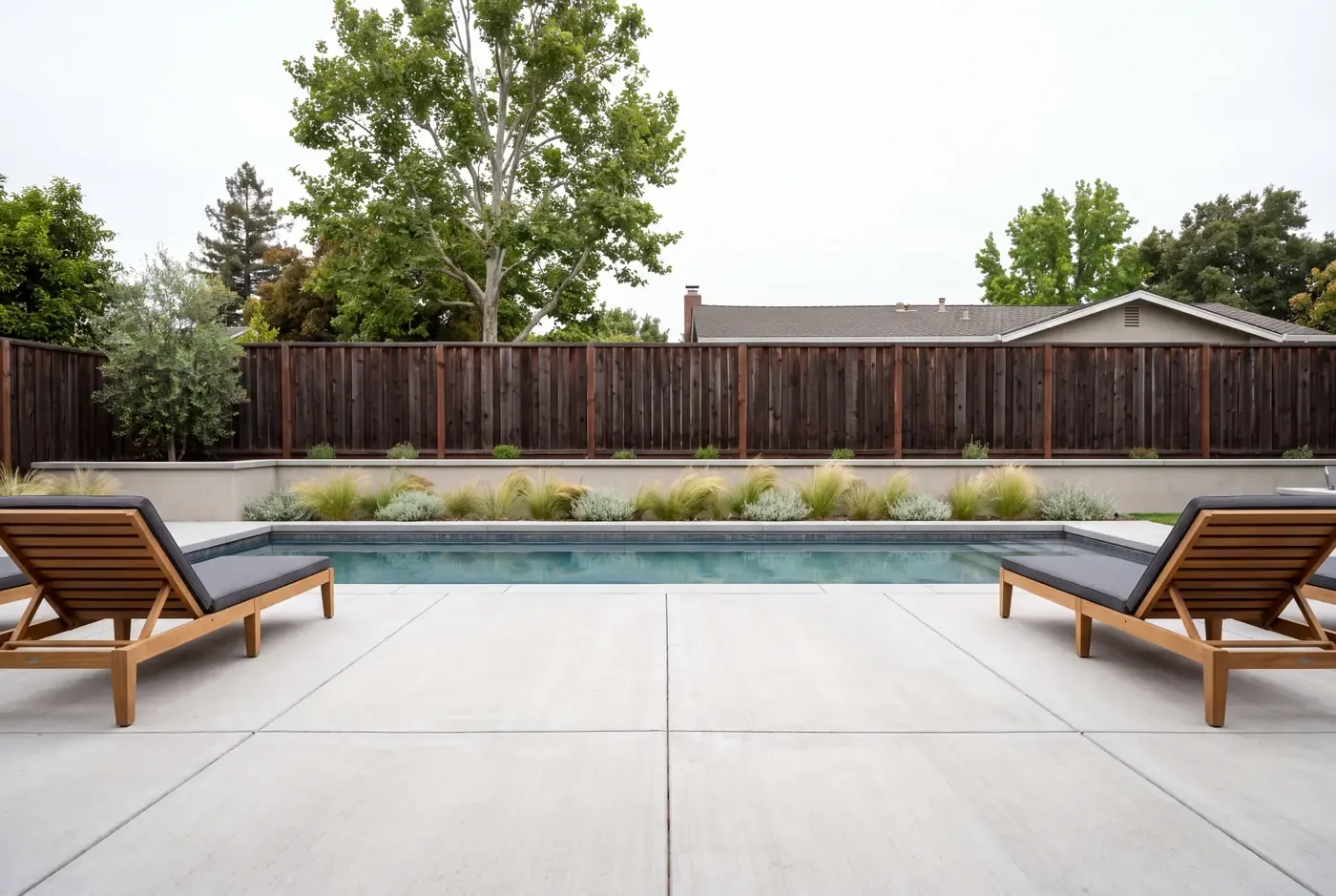
For tight budgets, broom-finished poured concrete with a light color hardener and proper control joints delivers a clean deck that meets the slip threshold and ages well. The cost driver for concrete is rarely the slab itself; it is the forming, the finish, and the drainage details around it.
The choices to be cautious about: dark bluestone (hot underfoot), polished stone (slippery when wet), and any surface that cannot be matched by a single unit repair years down the road.
A hardscape design package works through these tradeoffs as part of a larger landscape plan, with the same designer usually staying with the project from concept through final walkthrough. If a pool deck is part of a broader backyard plan, the pool and spa construction page is where we usually start; the deck material decision is one of the first things to pin down so the rest of the design can align around it.
The deck also has to fit the lot. On narrow or small backyards, the deck material often becomes the unifying element that ties the patio and the pool together — our small-lot pool design guide walks through how one calm material reads larger than a split scheme. If the question is whether a pool fits at all, the pool versus spa planning guide helps lay out both options before the material decision.